Privacy Policy
Processed temporarily. Stored locally.
Version 1.8 · Last updated 21 August 2026
What ScopeIQ processes
ScopeIQ processes submitted crawl inventories, URLs, paths, query strings, page metadata, and public PDFs selected for PDF Scope. Do not submit credentials, private URLs, confidential material, or sensitive personal data unless you are authorized to process it.
Processing and storage
The configured host temporarily processes selected imports sequentially. By default, your browser downloads and counts listed PDFs in memory when their hosts permit cross-origin access. If you select server-side processing or choose Continue on server for a blocked host, the configured host temporarily retrieves the selected PDFs and may use private temporary files. Completed workspaces, Project membership and context, decisions, and Client Reports remain in this browser's IndexedDB or local storage. ScopeIQ has no user accounts or permanent server workspaces.
Use and recipients
Data is used for requested analysis and service protection. The hosting provider may receive request logs; public-document hosts receive requests from your browser by default or from the ScopeIQ server when you select that fallback; Google Analytics receives browser metadata only after consent. ScopeIQ does not sell data, share it for behavioral ads, use it for AI or model training, or make significant automated decisions.
Retention
Browser data remains until you use Empty Cache or clear browser storage. Browser-downloaded PDF bytes are released after counting and are not saved by ScopeIQ. Normal server temporary artifacts are deleted after processing and exact interrupted leftovers are swept later. Bounded safeguard metadata expires after its existing one-hour, two-hour, 24-hour, or seven-day window; hosting logs follow the provider's settings.
Your choices and rights
You can change analytics consent above and delete browser-local data with Empty Cache. Where applicable, you may request access, correction, deletion, restriction, objection, or portability, withdraw consent, and complain to your supervisory authority. Contact privacy@colorbass.com.
Terms of Use
Use ScopeIQ only for lawful, authorized analysis; submit only data you may process and request only public documents you may retrieve. Do not evade access controls, probe private networks, overload services, interfere with others, or violate another party's rights. Review all measurements, rules, exports, quotes, and reports before relying on or distributing them.
System architecture and processing map
This map summarizes ScopeIQ's local-first data flow, trust boundaries, processing, storage, and cleanup.

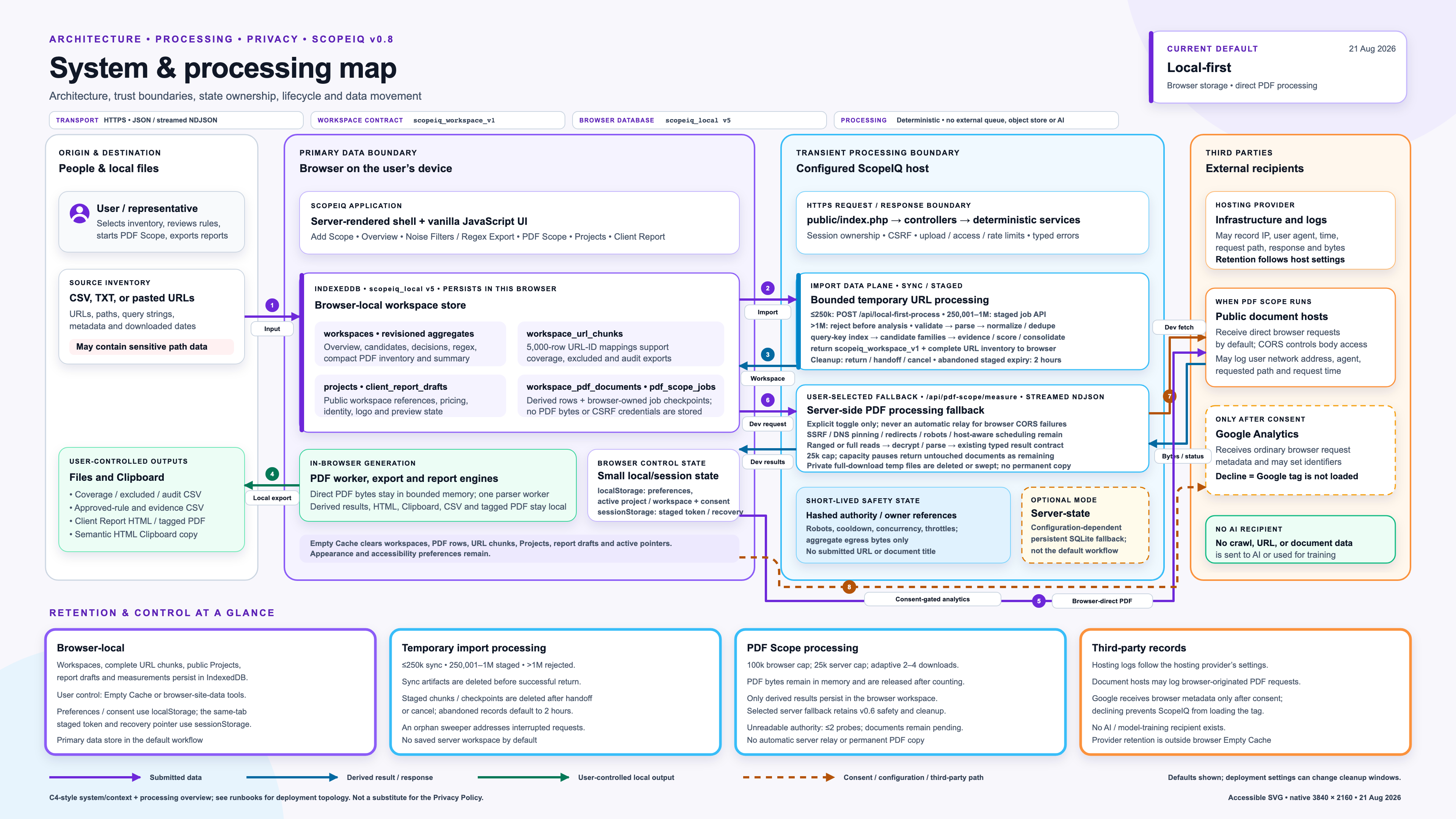
Text description of the system map
- Boundaries and interfaces: The browser uses HTTPS, JSON imports, direct cross-origin PDF requests, and the
scopeiq_workspace_v1workspace contract. - Import lifecycle: The configured host validates and analyzes imports, then deletes successful temporary sync artifacts or expired staged jobs.
- Browser state: IndexedDB holds completed workspaces, decisions, Projects, and report drafts, while local storage holds small preferences and consent.
- PDF Scope: The browser qualifies each document host, downloads compatible public PDFs through an adaptive two-to-four-transfer pipeline, counts them in one worker, saves only derived results, and leaves host-blocked documents pending.
- Outputs: Review decisions, CSV exports, HTML reports, clipboard output, and tagged PDFs are generated or retained on the user's device.
- External paths: Public-document hosts receive browser requests by default or server requests when the user selects that fallback, and Google Analytics loads only after consent; no submitted content is used for AI training.